What changes when your embedded platform just works?

RealThingks makes the embedded platform predictable, automated,and production-ready.

Book a Technical Deep-Dive

Late-stage integration failures aren’t a surprise anymore. They’re a pattern.

Every automotive software leader knows the cycle. When a BSW integration issue surfaces at HIL bench or at vehicle level, the fire drill begins with cross-functional teams scrambling for solutions, resulting in slipping timelines and compounding costs. And after the fix, everyone goes back to doing exactly the same thing on the next program. 

None of this is a reflection of the team’s ability. The truth is, the way the industry handles the embedded platform needs a fundamental revamp. Configuration is still largely manual and validation still happens toolate in the cycle. The institutional knowledge that holds it all together tends to live in the minds of a few experienced engineers rather than in the systems around them. It’s a structural challenge that the entire industry shares, andit’s one that’s long overdue for a different approach.

$22,000 The average cost of a single integration defect found at bench stage. The real cost including delays, bench time, and cross-teams crambles is often multiples higher.
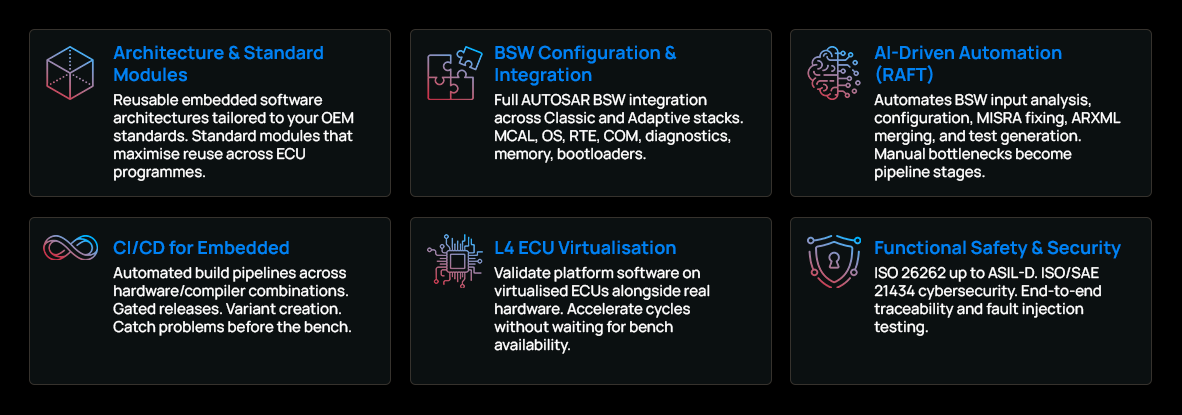
Systematizing the embedded platform is how you gain control of your development

When the integration bottleneck actually gets resolved, the impact goes well beyond improvement in efficiency and costs. It reshapes how the ECU development program operates and where the real value is created.

Predictability
Integration outcomes are validated before they reach the bench. Release timelines are grounded in data, not estimation, giving leadership the confidence to plan around commitments.
Supplier Accountability
Automated testing provides immediate, unambiguous trace ability to the origin of any defect. Resolution cycles shorten and remediation responsibility sits where it belongs.
Strategic Leverage
Moving from reactive firefighting to systematic delivery is not a cost-reduction exercise. It is the foundation of a lasting engineering capability.

Proven results from active OEM engagements.

$25M
Proven savings from early-stage testing of 6 SSW modules.
$36M
Net ROI on 100-module program. $44M savings vs $7.5M investment.
$220M
Projected savings at fullscale across 500+ modules over platform lifecycle.
Zero
Market-reported integration issues post-implementation. Not reduced. Zero.

Full-stack embedded platform based on AUTOSAR through one partner, driven by automation.

Seamless integration across your existing toolchain

Vector  ·  ETAS ·  Electrobit  · Siemens

Whether your environment runs on DaVinci, ISOLAR, Tresos, Capital Embedded or a combination of platforms, we configure, integrate, andvalidate across all of them, serving as a single partner for your entire embedded platform, while ensuring your existing tool chain delivers to its full potential.

Why OEMs choose RealThingks

Our teams have been delivering AUTOSAR embedded platforms since 2004 across brake ECUs, stability control systems, advanced head units, and high-performance zonal controllers, all currently in production with premium automotive OEMs.
Growth is driven by the RAFT framework and a templated execution process that institutionalizes knowledge, enabling consistent delivery at scale without a linear dependency on headcount.
Our work is validated up to ASIL-D, the most demanding tier of automotive functional safety, with certified systems currently operating in production vehicles.
Delivery teams operate from Düsseldorf, Gothenburg, Detroit, and Pune, providing the flexibility to support programs across time zones and geographies.
RealThingks holds membership in the AUTOSAR consortium and actively contributes to the Execution Management and Update & Configuration Management working groups.

The Next Step

The decision to systematize the embedded platform is not aquestion of if, but when. Every month that integration defects continue tosurface at bench stage rather than in the pipeline, the cost compounds. Every program that depends on institutional knowledge held by a small number of individuals carries risk that can be structurally eliminated. No one person orsingle team can oversee the complexities of modern vehicle networks, unless the program is systemized and automated. 

The OEMs we work with did not wait for the perfect conditions. They began with a single program, measured the results, and saw returns withinthe first cycle. If this resonates with where your program is today, a conversation is the simplest way to find out what’s possible.

Book a 30-Min Technical Deep-Dive →